Graphs and Musical Analysis

Typically when talking about graphs and music we talk about the graphing of sound waves.

Examples of Graphing Sound

From graphing a single sound wave, 

(https://www.sscc.edu/home/jdavidso/music/musicnotes/musicnotes.html)

to graphing a recording of a piece, 

we can see some basic uses of graphing in music. Each graph gives us specific information about what we are looking at. In analyzing the graph above we can quickly see where the sound dissipates and where it is loudest.

Key Components of a Graph

In every graph there are some key components that help us read and understand what it is saying. We are focusing on graphs using a cartesian coordinate system. Basically, it is the usual graph you are used to seeing. Each point can be defined by an x-coordinate and a y-coordinate where the x-axis and y-axis are defined to provide meaning to points on the graph.

Music is a time art; it changes over time. For that reason, almost all graphs relating to music have the x-axis defined as time. The definition of the y-axis is then very crucial to provide understanding. As I said earlier, almost all graphs about music that we see today use the y-axis to represent decibels (dB) to show the intensity of sound, and are usually used in the recording studio.

New Ways to Use Graphs in Music?

What if graphs could be used as a useful tool in other areas of music creation, performance and analysis? Can a graph be used to plot y-values that are more subjective than dBs? Over the next few posts I hope to show new ways of using graphs to help visualize and analyze the various aspects of music and how they can be used in a practical way when composing, rehearsing, and analyzing music.

So what’s next… Next post coming soon (Graphing Musical Energy)

One thing to keep in mind throughout my posts is that graphs are simply a tool. In my opinion a piece of music should not be reduced in this way to determine whether or not it is “better” or “worse” than another. However, graphs could be a helpful way to gain insights into a piece or group of pieces.


Music and Dooyeweerd’s Cosmonomic Philosophy

I had the privilege of studying music at The King’s University (https://www.kingsu.ca/programs/bachelor/music) under the tutelage of Dr. Jacobus Kloppers (https://jacobuskloppers.ca/musicology/). One thing I won’t forget is exploring Dooyeweerd’s Cosmonomic Philosophy and how it can be applied in musicology. I’m not going to get into the philosophy in great detail here except to grossly generalize it as avoiding a dualistic worldview by admiring the qualities and attributes that something has. Check out http://kgsvr.net/dooy/summary.html if you would like to read more about it.

So how does this philosophy apply to my posts about graphs and music, well lets start by taking a look at the various qualities of music and see which of these qualities we want to take a look at graphing.

(^^^ Myself trying to remember what was on that dang whiteboard in class over 10 years ago)

(and then realizing it’s all online!!!!)

You can read Dr. Jacobus Kloppers – A PHILOSOPHY OF MUSIC WITHIN A CHRISTIAN WORLD- AND LIFE VIEW (2013) (https://jacobuskloppersca.files.wordpress.com/2018/02/a-philosophy-of-music-within-a-christian-world-and-life-view-1991.pdf) online. Page 11 contains a breakdown of the various aspects their various related disciplines and musical terms, topics and metaphors. Here are the aspects for quick reference.

Various Aspects of Music

Variations of the aspects above can be used to attribute different pieces of music to help us understand music in a non-musical way. In the same way music can be defined as embodying any combination of the qualities above in a uniquely musical way.

So, of these aspects which ones have the best opportunity to be analyzed graphically and produce a useful result. I would say any aspect that has qualities that can vary throughout a piece and can be understood quantitatively. Here is my list in order of how I will address them in future posts.

Aspects to be analyzed graphically – musical terms, topics and metaphors from Dr. Jacobus Kloppers – A PHILOSOPHY OF MUSIC WITHIN A CHRISTIAN WORLD- AND LIFE VIEW (2013) pg. 11

Energetic
Dynamics, balance, sforzando; powerful, energetic playing; passiveness; conflict; “coldness” or “warmth” of tone; accelerando, diminuendo

Kinematic
Movement (slow, fast, moderate), accelerando, ritenuto; contrary or parallel motion; imitation; sound vibration; a “moving” performance; “static” playing; gestures

Spatial
Pitch (“high”, “low”), “depth” of sound, “shallow” tone or effect; a “great” performance; “thin” or a too “thick” sound; a too “confined” approach; expansion; augmentation

Biotic
Musical pulse in music; vitality of playing; breathing (singing); technique of singing or playing (action of vocal chords, fingers, membranes); rests, aural skills; dance

Psychical
“Exciting” performance; creation of moods, tension, psycho-dynamic unity; climax, sensitivity, emotional involvement; individualistic approach, personal style; musical therapy

Aesthetic
“Enjoyable” quality; “beauty” in music, aesthetic merit, harmony, dis-chord, unity of concept, etc. (dependent on the manner in which other aspects are integrated)

Logical
Logical construction, coherence, continuity, unity; synthesis, contrasts, development, disintegration; discontinuity (ellipsis); interrupted cadence; musical analysis; humour (based on paradox)

Historic (I am taking a risk with this one)
Music as a “memory construct”; conventional or contemporary style; historic idioms, mediums, genres; playing “from memory”; re-occurrence of themes, recapitulation; recorded music; history of music; historiography of music

Even though the other aspects Faith, Ethical, Juridical, Economic, Social, and Symbolic may be able to be graphed if we think creatively enough about it, they are less likely to change over the length of the piece of work.

So what’s next… Graphs and Musical Analysis

Am I missing any aspects or qualities? Comment about it and I will look at getting that quality added to the list of things to analyze. Or maybe you disagree with the list of Aspects as proposed by Dr. Kloppers, comment away.

Graphs and Music Introduction

Graphs… boring. Blog post done. Okay, hold on a second. You may say to yourself, “I’m a musician, I know people keep saying music and math are related but I suck at math and therefore am not interested in reading about this.” Or you may say, “I was good at math, but graphs are purely a mathematical construct and are too formulaic to be useful in music.” Well, HOLD ON TO YOUR BRITCHES!

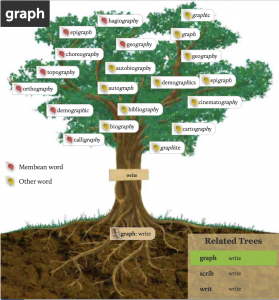
‘Graph’ is another one of those Greek words that is used all over the place. If you checkout the diagram below (http://membean.com/wrotds/graph-write), the word graph is used a myriad of ways.

The root meaning of the word is to ‘write’. For example, Graphology according to dictionary.com (http://www.dictionary.com/browse/graphology) is “the study of handwriting, especially when regarded as an expression of the writer’s character, personality, abilities, etc.”

In this series of posts I will be exploring the various usages of graphs in music and will be proposing some alternate ways to use graphing as a technique to help with musical analysis, composition, pre-performance meditation, education, and any other topics that may come up.

“So what kind of graphs are you talking about David?” Well, I am going to start with a focus on graphs similar to those seen in mathematics, like plotting on a cartesian plane, however the units may be a little vague and the definition of the origin may be quite subjective. That’s probably where the art of it all comes in. I might also throw in a little something about graphology of original scores too, who knows?

So where to begin… Music and Dooyeweerd’s Cosmonomic Philosophy!